Showing posts with label Design. Show all posts

Sunday, 4 January 2015

Art Nouveau Design Essay

Art Nouveau was an art and design movement that originated from 19th century Western Europe till the First World War. Art Nouveau was a style that influenced a lot of media, from art to architecture and furniture because of its decorative and organic nature. (The History of Art Nouveau – Painting-Drawing-Artist Documentary, 2014)


The idea of this movement was born when British artists saw Japanese designs. At that time, Japanese art style was new and original for the British as well. Art Nouveau was a movement that was mainly inspired from nature itself. Thus, designers and artists relied on many organic forms and shapes, very decorative material and patterns and the sense of flow. Art Nouveau was also influenced from the arts and crafts movement as they focused a lot on the aesthetics of the object. Opposite to the arts and crafts movement, Art Nouveau designers were quite happy with mass production. (The History of Art Nouveau – Painting-Drawing-Artist Documentary, 2014)

Many Art Nouveau designers believed that the function of the object should follow and shape its form.

Art Nouveau design had two different styles, one that consisted more of organic and decorative style while that of German Art Nouveau consisted more of geometric forms and were less decorative than the organic ones. (Lecturer’s notes)

The Majolica House is a clear example of organic Art Nouveau design by Otto Wagner. At that time, Wagner was part of the Secessions movement and they mark a new and revolutionary way of enlightenment. Although the building itself is rectangular in shape, the flower patterns are a typical Art Nouveau style commonly found on other media such all wallpapers or in fashion. Seeing this amazing pattern as an exterior decoration of a building is quite original. The colourful pattern is also quite original and gives a sort of character to the building itself. One could see the same design on the metal railings as well. (Housing Prototype, The Majolica House)
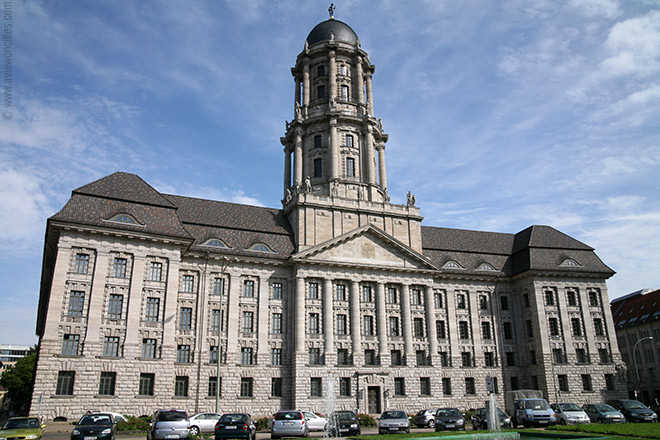
The Altes Stadthaus is an example of German Art Nouveau designed by Ludwig Hoffmann. This building is less decorative then the Majolica House, as because German Art Nouveau was less decorative. The building consist of a lot of geometric forms but what I find interesting is the effect the shade cast on to the building itself. (Altes Stadthaus, 2014)


Although Art Nouveau disappeared before the First World War, today it is still being practiced by designers and artists because of its beauty. We can see these revivals in forms of art, in fashion, graphic design, and jewelry and even in furniture and architecture.


Here is a modern take on modern Art Nouveau architecture using wood. The architects manage to combine organic and geometrical shapes together to create this beautiful exterior. The vertical lines create an interesting effect because of the shadows while the flowness and continuity of the organic lines create a sense of “freedom”. What is also interesting is the contrast between the wood and the glass material as well.


Bibliography

1.) The History of Art Nouveau – Painting-Drawing-Artist Documentary, 2014 (video file), Available from: <https://www.youtube.com/watch?v=zjy_XFUjSn0>. [Accessed 29 December 2014]
2.) Wolf, Art Nouveau, 2014, The Art Story, Available from: <http://www.theartstory.org/movement-art-nouveau.htm> [Accessed 29 December 2014]

Sunday, 23 November 2014

Art Nouveau

Art Nouveau
From 1880s till the First World War, Western Europe and the United States witnessed the development of a new art movement called “Art Nouveau”. The two major influences of Art Nouveau were from the Art and Crafts movement by William Morris and the Japanese art style during that time. Art Nouveau style could be divided into two; one that consisted more of natural and organic shapes and design while the other that consisted more of geometric shapes. Organic Art Nouveau style is mostly influenced from nature and flow. Artists and designers were influenced by Art Nouveau thus many paintings, furniture and buildings were created with this new form of style. One could even find this art style in posters as well. The aim of this movement was to modernize design by using different and more new materials instead of the traditional ones. Art Nouveau started to lose its popularity during the 1920s, when fashion started to give way to Art Deco but made another come back during the 1960s in which is now seen as an important influence during the Modernism movement.


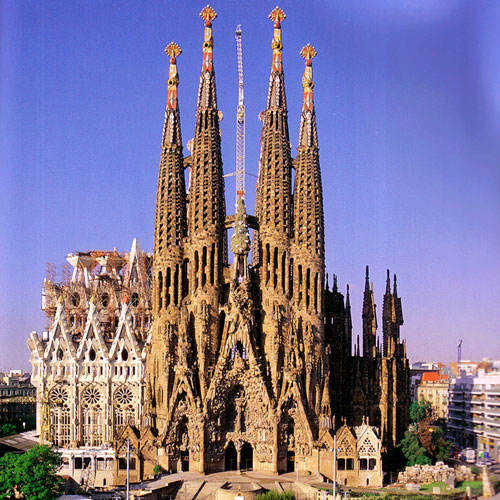
Sagrada Familia byAntoni Gaudi
This very large Catholic Church built by Antoni Gaudi combines both Gothic and Art Nouveau style of architecture beautifully. What’s interesting is that I find both of these style direct opposites of each other; Gothic is more geometrical and pointed in form while on the other hand Art Nouveau is more organic and flowing in style. The building was never complete and to this day, the building’s construction is being continued. As mentioned before, the building has a beautiful balance of organic and geometric design. The building also has a sort of value balance because of its interesting mixture of lines as a decorative feature. The position and size of the pillars in the middle also help to make the building more attractive and pleasing to the eye.

Art Nouveau Lillies by Sabina Frank

This contemporary Art Nouveau style stained glass has a simple yet effective decorative design. The colours complement each other while the position of the flowers gives a balance of positive and negative space. There is also a balance of organic and geometric lines as well.

References
1.) Gontar, Art Nouveau, Available from: http://www.metmuseum.org/toah/hd/artn/hd_artn.htm, [20 Novemeber]
2.) The Art Story, Art Nouveau, Available from: http://www.theartstory.org/movement-art-nouveau.htm, [20 November]

The Dada Movement

The Dada Movement
The Dada movement originated from Zurich by poets and artists that was a direct reaction towards all of the propaganda and slaughter during the events of World War 1. The style shocked everyone with its unique simplicity. The style quickly spread to many other countries as well. The artists didn't share a universal style but they shared some similar concepts. This anti-art movement consisted or art that rejected idealism, and wanted to represent the direct opposite of what art meant. Dada in addition as wanted to ignore aesthetics as well to further increase its rebellious style. Dada style was commonly represented with typographic styles or printed images. Many of these images didn't have any meaning what so ever as well; they were all dependent on the viewer’s point of view. After The First World War, many artists or designers that participated during this movement, started to practice surrealism. In contrast to the Dada movement, surrealism consisted of images and writings that usually depicted illogical and strange looking scenes that expressed the artist’s idea.
Today Dadaism and Surrealism is still found among us. The style is commonly found in gravity because of its rebellious nature. Some modern fashion trends also originated from Dadaism such as punk fashion. Dadaism is commonly found in the graphic design area as well. For example of this contempory Dadaism, one could look at “Nu Bodies” by Edward Fella.

Small Dada Evening by Kurt Schwitters 1923
This poster consisted of a lot of jumbled typography written on top of each other and some small images of hands, a deer’s head and an arrow. Bold red letters that spell “DADA” and written in various rotations as well. The poster has an asymmetrical balance between the size of the typography and colour. The thickness and the red colour of the letters that spell DADA all help the viewer to easily read these. They also help to make the poster to look somewhat more attractive to the eye as well. Since not all letters are written with the same font style, this breaks repetition and in my opinion makes the poster more interesting to look at as well.

References
1.) Linotype, Dadaism, Available from: http://www.linotype.com/786-18052/thedadamovementtoday.html, [20 November 2014]
2.) Oxford Art Online, Dada and Surrealism, Available from: http://www.oxfordartonline.com/public/page/themes/dadaandsurrealis, [20 November]
3.) Fella, 2010, Graphic Design and Postmodernism, September 3 2010, DCAIGA, Available from: http://dcaiga.blogspot.com/2010/09/graphic-design-and-postmodernismedward.html, [20 Novemeber 2014]
4.) Moma, Kleine Dada Soiree, Available from: http://www.moma.org/learn/moma_learning/2562-2, [20 November 2014]

Sunday, 26 October 2014

Victorian Era

Victorian Era
During the Victorian Era, technology was slowly starting to improve and many important innovations took place during this time. These innovations included the blast furnace in which slowly started the production of steel, the print works, textile mills, the elevator and even typewriters. During this time, there was also an expansion in the middle class because of the rise of the industry and work. Because of this, people started to afford to live comfortably and could even buy some art works as well. Victorians loved to show off their possessions, thus houses were often very decorative. During this time, historicism was common as architecture and even interiors were built to imitate Gothic and rococo designs; such example of this would be the St. Pancras railway station as it was built in a Neo-Gothic style. During this time, there was also an increase in mass production because of the new technological advances.


William Morris
William Morris was a designer and leader of the arts and crafts movement. William Morris believed that machines were degrading creativity in design. He believed that handcrafts are far superior as it gives a sort of personal feel of the designer into the product. Morris was heavily inspired by nature ranging from plants to animals as well.


Red House 1859-1865
Red House is Neo-Gothic house design by William Morris and Philip Webb that shows a very unique design during that time. The rich red colour compliments the green grass around it. The grass helps to balance out the colour of the house. The balance of different angled lines help to give the house a powerful and complex look as well. The circled windows give a nice touch of visual balance as well.


References
1.) Victorian Architecture, Available from: http://en.wikipedia.org/wiki/Victorian_architecture [18 October 2014]
2.) The Victorians, [online video], 2014, https://www.youtube.com/watch?v=jBNFdP2xr7c (accessed on 18 October 2014)
3.) Loftus, 2011, The Rise of The Victorian Middle Class, Available from: http://www.bbc.co.uk/history/british/victorians/middle_classes_01.shtml [18 October 2014]
4.) Red House London, Available from: http://en.wikipedia.org/wiki/Red_House,_London [18 October 2014]

5.) William Morris part 2, [online video], 2011, https://www.youtube.com/watch?v=wL3Zu05KVGo (assessed on 18 October 2014)

Saturday, 25 October 2014

The Industrial Revolution

The Industrial Revolution
The origin of the industrial revolution started in England during the 18th century. Before this time, most people lived in a simple agricultural life, but then as the 18th century progressed, the industrial revolution began in which it transformed life with the help of new technology. During this time period, many important innovations began such as the use of coal, the first steam powered engine, railroads, factories, textile inventions, free trade and the iron industry. Although during this time, Britain gained maximum power and a lot of technological advancements, many people suffered for the cost of maximum gain. 


The Great Exhibition
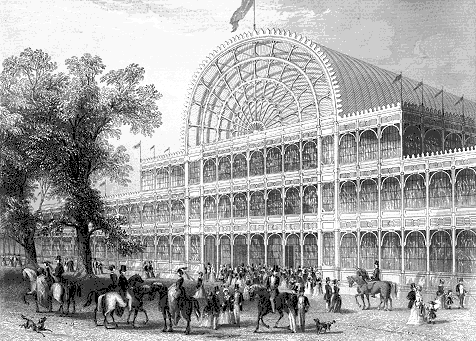
During the 19th century, there was an international exhibition in London from 1st of May till the 11th. This exhibition, organized by Prince Albert and Henry Cole, celebrated the technological advancements and design. Many famous figures such as Charles Darwin and Charles Dickens visited this exhibition as well. This exhibition was held in a large glass building nick named “The Crystal Palace”.

The Crystal Palace

This large building, design by Joseph Paxton, held The Great Exhibition event. It was built with cast iron and plate glass; this gave the building a very unique form during that time. When one would see this building, one would see a balance of positive and negative space because of the iron and plate glass. I believe that during the day, the building would have reflected a lot of the sunlight because of the glass, thus it would have looked like its lit. The building has also showed balance on horizontal, vertical and curved lines as well. Inside the building, full sized Elm trees were also placed; this further gave a contrast between nature and architecture. This building was considered as an engineering success. The building was then moved to Sydenham where it was later destroyed by fire on the 30th of November 1939.

Architecture
In the 19th century, many historic styles were revived such as Neo-Moorish, Neo-Turkish, Neo-Egyptian and Neo-Gothic. These styles were very similar to the previous ones, but they were built using different and modern techniques.


Neo-Gothic Architecture: St. Patrick’s Cathedral
When one looks at The Cathedral of St. Patrick, one would immediately notice the similarities with Gothic-architecture. The building has a symmetrical balance with a balance of horizontal, vertical, curved and diagonal lines. This gives out a very complex look to the building. The building itself has an asymmetrical balance with its surroundings as the building looks very unique and different compared to the buildings around it. This attracts the eye of the viewer to look at the building.

Owen Jones
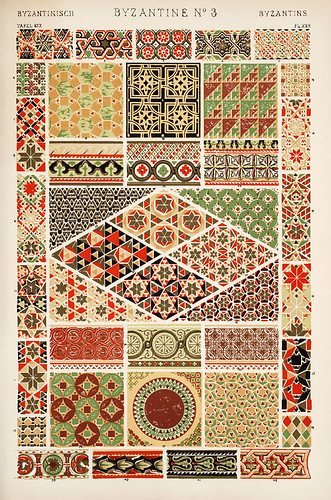
Owen Jones was an architect that was famous for his decoration design on the Crystal Palace and for the arrangements of the exhibits.  He is also known for his pattern catalog that he created called "The Grammar of Ornament". This involved of numerous of different pattern designs that could inspire and encourage designers to understand these patterns better. Each pattern in the catalog was very detailed and had vibrant colours. They were all balanced symmetrically balanced and many of them had complimentary colours as well.


References
1.) The Great Exhibition. Available from:http://en.wikipedia.org/wiki/The_Great_Exhibition [15 October 2014]
2.) Industrial Revolution, [online video], 2013, https://www.youtube.com/watch?v=JhF_zVrZ3RQ, (accessed 15 October 2014)
3.) Ben Johnson, The Great Exhibition of 1851, Available from: http://www.historic-uk.com/HistoryUK/HistoryofEngland/Great-Exhibition-of-1851/ [15 October 2014]
4.) St. Patrick's Cathedral (Manhattan), Available from: http://en.wikipedia.org/wiki/St._Patrick's_Cathedral_(Manhattan) [15 October 2014]
5.) Owen Jones (architect), Available from: http://en.wikipedia.org/wiki/Owen_Jones_(architect) [15 October 2014]